Progress on the Development and Use of the Career Education and Development Scales
12/11/2024
Dr Col McCowan OAM is the Director of Cromach Careers. He is a registered psychologist, educator and counsellor who has extensive experience working with individuals, systems and countries in secondary and tertiary education fields, in governments at strategic and policy levels, and as a consultant / project manager. He was the recipient of the 2024 CDAA Award for Excellence in the Research Category.

Back in 2022, I penned a blog post for Career Panorama about my development and validation of four Career Education and Development Scales (CEDS) for students at Primary, Lower Secondary, Upper Secondary and Tertiary levels of Education. This blog provides an update on the progress of the four CEDSs.
I completed my PhD with Professor Peter McIlveen at The University of Southern Queensland earlier this year. All four scales, plus their Vietnamese translations, and the underpinning Career Education and Development Framework (CEDF), were empirically validated after the extensive research we undertook.
This included the use of - Principal Axis Factoring, Confirmatory Factor Analysis, Invariance testing and Correlation studies involving current validated scales. This work was published in three Journals, the Australian Journal of Career Development, The Career Development Quarterly, and the International Journal for Educational and Vocational Guidance.
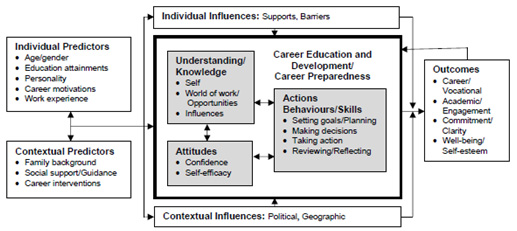
My adaption of the integrated Career Preparedness (Career Education and Development) Model, developed by Marciniak et al. (2022), shown below, frames the work I have done to date, practically, theoretically and empirically. It places our work, into the middle/gray sections (the engine room) of the model.
Use of the Scales in Vietnam
In the research process in Vietnam, the scales were translated both ways to ensure an accurate understanding of the meaning and intention of each of the items. After an extensive pilot study with 16 students in Grade 12, none of the items needed to be changed. Since then, Phoenix Ho and her team at Song An in Vietnam have successfully integrated the use of the Vietnamese translations of the CEDS into their practice, particularly with the training of teachers and career professionals.
The International Labor Organization – Vietnam (ILO-Vietnam) in collaboration with the Song An team, used the finding of our research to produce a country report on the career thinking of Vietnamese students in secondary and tertiary institutions across the breadth of Vietnam.
Use of the Scales in Australia
In Australia, a great example of the use of the CEDSs is the work by Mark Anderson, the career practitioner at Shenton College in Perth. He was challenged with the task of determining the level of career learning in students across the whole college and then developing a whole-of-college career curriculum framework, lessons and resources, based on the outcomes of the findings from the audit.
Because all of the CEDS use the same underpinning framework, he was able to map the responses, by student, class, grade and gender, from over 2000 students from Grades 7 to 12 against the parallel components, factors and items, contained in the CEDF and the CEDSs. By examining the pockets of strength and pockets with low scores, he has been able to tailor his future programs, to address the issues which the audit identified.
I am looking forward to the work in 2025 by Lucy Sattler who is exploring ways to integrate the CEDS into her Pondering Careers programs. Discussions are also in train with The University of Southern Queensland and James Cook University researchers, to integrate the CEDF and the four CEDs into their research activities in 2025.
I am hopeful that my presentation at the 2024 CDAA conference and receiving the CDAA Research Award, will stimulate many career professionals and researchers to consider integrating the use of the CEDF and the CEDs into their practice in the future.
The four scales can be downloaded from my website.